Roofing PPC: The Best Paid Ad Strategies to Get Leads in 2026

Most roofers run Google Ads in isolation — a campaign here, a Facebook ad there — and wonder why results are inconsistent. The roofers who win consistently use PPC as one piece of an omnichannel lead system: paid search catches homeowners the moment they search, retargeting follows them across the web, and automated follow-up closes the gap between "clicked your ad" and "booked the inspection." This guide breaks down how PPC fits that system and what it actually costs.
Quick answer: PPC for roofers costs $80–220 per qualified lead depending on your market. Google Ads targets homeowners actively searching right now. Google LSA charges per qualified call. Combined, they are the fastest way to fill your pipeline while SEO builds long-term.
How does Pay‑Per‑Click (PPC) advertising work for roofing companies?
Pay‑Per‑Click (PPC) advertising lets roofing companies bid on specific keywords (such as "roof repair near me") or audiences so their ads appear on search engines and social platforms. You only pay when someone actually clicks your ad, which shifts your spend from "paying for views" (like billboards) to "paying for action" in the form of targeted traffic to your website or landing page.
Is Google Ads or Facebook Ads better for roofing PPC?
For immediate, high‑intent roofing leads, Google Ads usually wins because it targets homeowners who are actively searching for solutions right now (e.g., "roof leaking in bedroom"). Facebook and Instagram Ads are better for brand awareness, storm campaigns, and proactive offers where you target homeowners by location and demographics before they start searching.
Is PPC advertising worth it for local roofers?
Yes—PPC is one of the fastest ways for a local roofer to start the phone ringing, especially in competitive markets where SEO takes months to gain traction. A well‑managed PPC campaign can put your business at the top of search results within days, generating calls and form fills while you build your longer‑term SEO and referral engine.
Stop Waiting for Leads — Make Them Click
The Strategic Advantage: Why Wait for Word‑of‑Mouth?
In roofing, there are two ways to get leads: you can wait for them (referrals, SEO, repeat customers), or you can go get them with PPC and outbound. PPC is "air support" for your sales team—it lets you show up exactly when a homeowner realizes they have a roof problem and starts searching for help. While SEO builds your long‑term fortress, PPC is the rapid‑response unit that can be turned up or down like a faucet as your crew schedule changes.
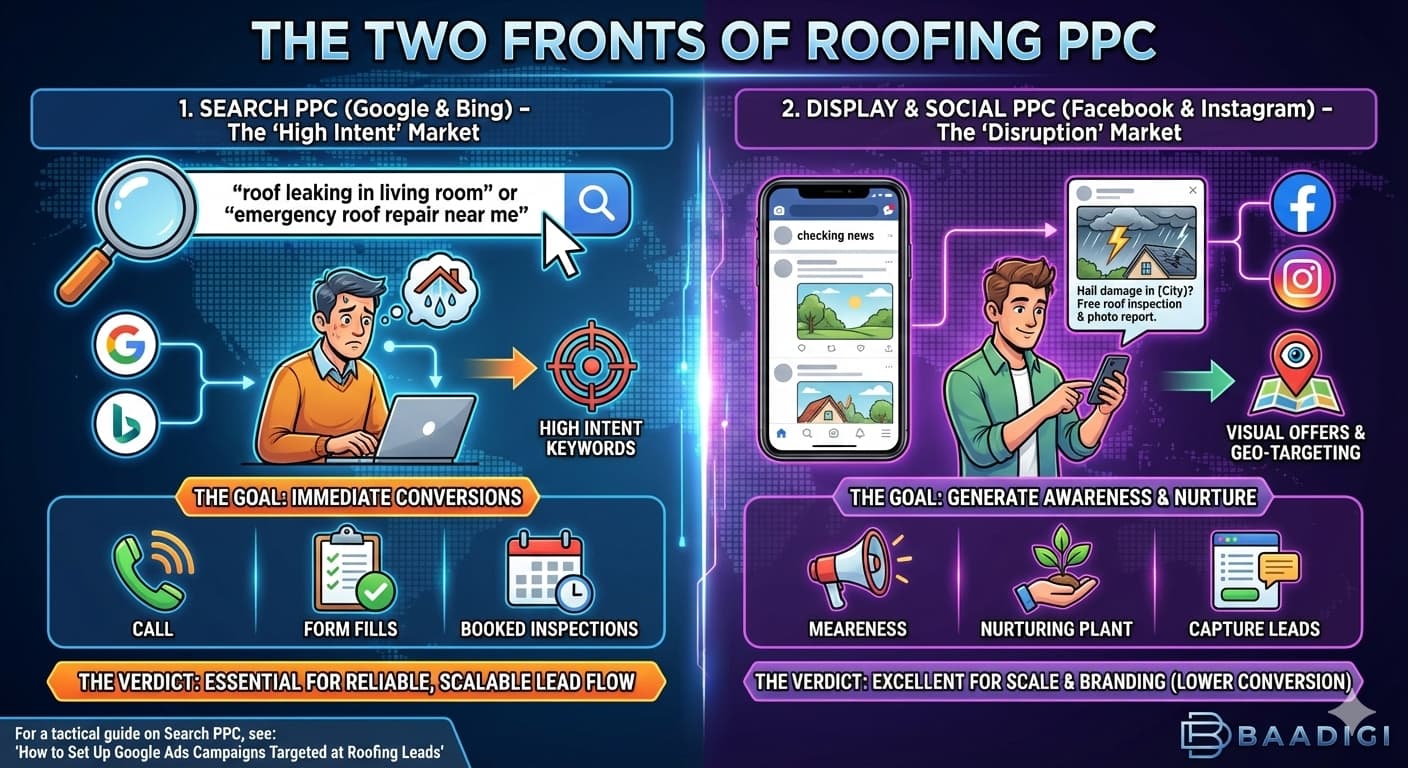
The Two Fronts of Roofing PPC
Not all clicks are created equal. To consistently generate roofing leads, you're usually fighting on two main fronts.
1. Search PPC (Google & Bing) – The "High Intent" Market
This is where the highest‑intent roofing leads live. A homeowner types "roof leaking in living room" or "emergency roof repair near me" into Google because they need help now.
- The strategy: Bid on tightly themed, high‑intent keywords so your ads appear exactly when homeowners ask for help.
- The goal: Immediate conversions—phone calls, form fills, and booked inspections from people ready to take action.
- The verdict: Search PPC is essential for almost every roofer that wants reliable, scalable lead flow.
If you want the full nuts‑and‑bolts buildout (campaign types, match types, negatives, landing pages, and tracking), read our tactical guide: "How to Set Up Google Ads Campaigns Targeted at Roofing Leads" for a step‑by‑step walkthrough.
2. Display & Social PPC (Facebook & Instagram) – The "Disruption" Market
On social, homeowners aren't actively searching for a roofer—they're scrolling photos, checking news, or chatting with neighbors. Your job is to interrupt that scroll with a compelling, relevant offer:
- The strategy: Use geo‑targeting and interest targeting to reach homeowners in specific neighborhoods with visual offers like "Hail damage in [City]? Free roof inspection & photo report."
- The goal: Generate awareness, nurture interest, and capture leads through forms or messages—especially for storm restoration, coatings, and aesthetic upgrades such as metal or tile.
- The verdict: Social and Display are excellent for scale and branding, but they typically have lower immediate conversion rates than Search because intent is lower.
The "Cost" vs. "Investment" Mindset
Rookie owners ask, "How much does a click cost?" while veterans ask, "What is my Customer Acquisition Cost (CAC) and lifetime value?" If you pay $150 per qualified lead and close one out of three, your CAC is about $450; if the average retail roof is worth $10,000–$15,000 with strong margins, that's not a cost—that's a controlled money machine. Baadigi's rule of engagement: never cap a profitable campaign just because the daily spend looks scary; cap your spend based on your team's capacity and your ability to profitably install the work.
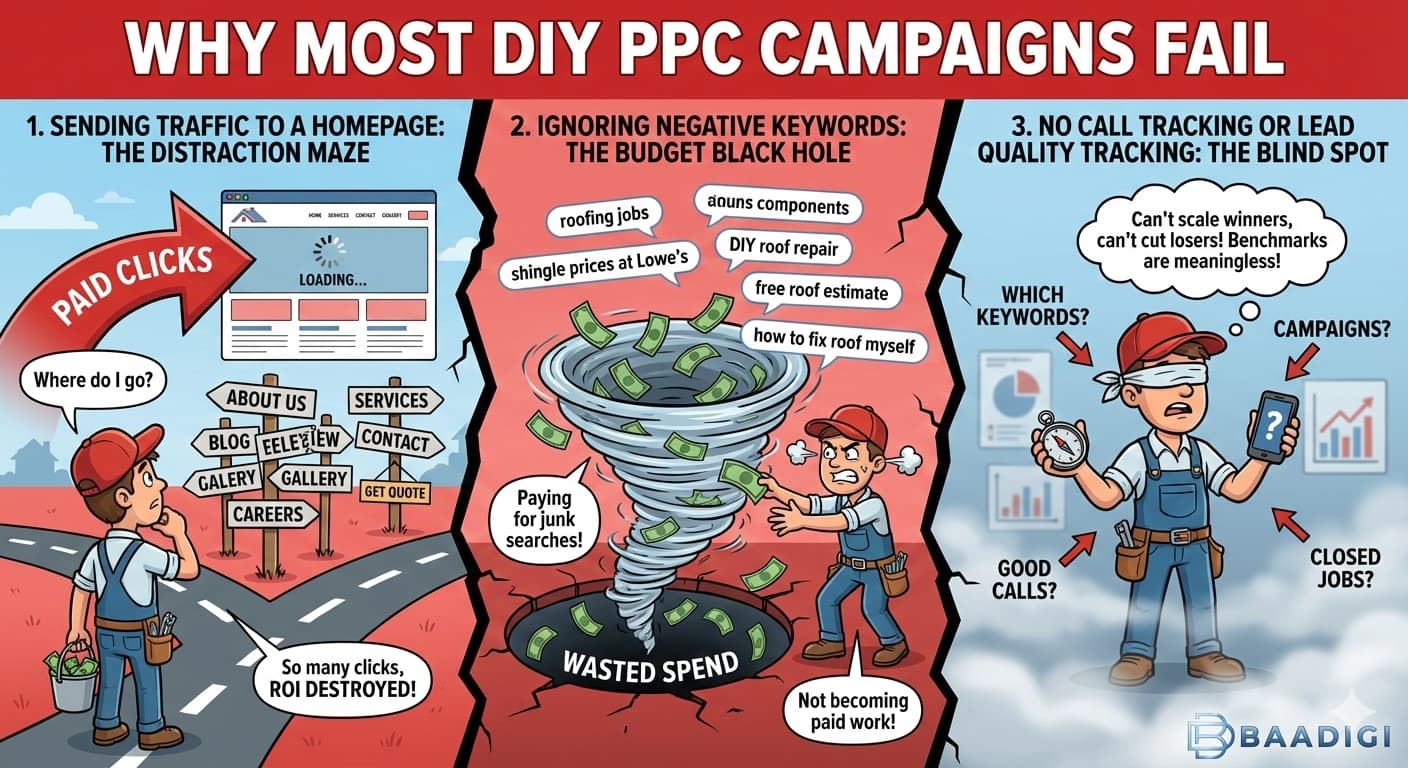
Why Most DIY PPC Campaigns Fail
We've audited many roofing ad accounts, and the failure points tend to repeat.
- Sending traffic to a homepage: Paying $30–$60 per click to send people to a generic homepage with menus and distractions is one of the fastest ways to destroy ROI—use focused landing pages instead.
- Ignoring negative keywords: Without a solid negative keyword list, you end up paying for searches like "roofing jobs," "shingle prices at Lowe's," or "DIY roof repair," which rarely become paid work.
- No call tracking or lead quality tracking: If you can't see which keywords and campaigns actually produced good calls and closed jobs, you can't scale winners or cut losers, and "benchmarks" become meaningless.
The Baadigi Differentiator: One Client Per Territory
The biggest hidden risk in roofing PPC is bidding wars created by your own marketing partners. If a generic agency runs Google Ads for multiple roofers in the same city, your budget is literally competing against your competitors' budgets through the same manager. At Baadigi, we avoid that conflict by working with one client per territory and building exclusive campaigns aimed at market dominance in your chosen zip codes. We design systems around algorithms—tight tracking, data‑driven optimization, and aggressive negative filtering—rather than chasing "cheap clicks" that never turn into profitable jobs.
National FAQs
Can I run PPC ads for roofing on a small budget?
You can run PPC on a small budget, but expectations must be realistic: in competitive roofing markets, a $500/month budget won't produce much data or volume. A better approach is to start with enough to generate at least 20–30 targeted clicks per week (often $1,500+/month in many metros) so you can actually test, optimize, and identify winning keywords and ads.
How do I track if my PPC ads are actually working?
You need end‑to‑end conversion tracking, not just click counts. That means tracking calls, form submissions, and booked appointments back to the exact campaign and keyword that generated them, typically using Google Ads conversion tracking, Google Tag Manager, and call‑tracking software integrated with your CRM. You should be able to answer, "How many dollars did we spend, and how many quality leads, appointments, and jobs did we get?"—if your current agency can't show that, it's a red flag.
What is the difference between PPC and Google LSA?
Traditional PPC search ads are text ads that show in the search results and charge you when someone clicks. Google Local Services Ads (LSA) appear above regular ads with a "Google Screened/Guaranteed" badge and typically charge per qualified lead (call or message) instead of per click, making them feel more "pay‑per‑lead" than pay‑per‑click.
Should I bid on my competitor's business name?
Bidding on competitor brand names as keywords ("conquesting") is a common aggressive tactic and is generally allowed, as long as you don't use their trademarked name in your ad copy. It can be an efficient way to capture comparison shoppers, but you should expect some pushback and be prepared for competitors to do the same to you.
Do people actually click on roofing ads?
Yes. For urgent home services like roofing, the top paid results grab a large share of clicks because homeowners want a fast solution and often call one of the first companies they see. When water is coming through the ceiling, most people don't scroll past the top ads to do deep research—they pick a provider quickly, which is why a strong paid presence matters.
Is Bing/Microsoft Advertising worth it for roofers?
Bing (Microsoft Advertising) has a smaller share of search volume than Google—often around 10–15%—but its users skew slightly older and higher income, and clicks are frequently cheaper. For roofers who are already performing well on Google Ads, adding Bing as a secondary channel is often a cost‑effective way to squeeze out extra high‑intent leads.
Ready to Move Beyond "DIY" Marketing?
PPC is a powerful weapon, but it is just one component of a dominant local digital marketing strategy. To see the full picture of how we build market share—from LSA mastery to organic authority—read our complete 2026 guide to generating exclusive, high-quality commercial and residential jobs. If you are ready to stop learning and start earning, call Baadigi today at (714) 707-2483 to claim your territory before your competitor does.
Sources & Further Reading
Keep Reading:
- Roofing Lead Generation: The Complete 2026 Guide
- SEO for Contractors — How we rank roofers #1 in their service area
- PPC Advertising for Contractors — Google Ads + LSA management
- The Predictable Work Engine™ — Our complete lead-to-job system
Free website audit — see what's costing you leads
No email required. Takes 2 minutes. Completely free.
Get contractor marketing tips in your inbox
Join contractors getting weekly SEO, PPC & lead gen playbooks — free.

Ryan Goering
CEO & Founder, BaaDigi
U.S. military veteran and digital marketing strategist who built BaaDigi to help contractors generate predictable leads and revenue. 15+ years in SEO, PPC, and AI-powered marketing automation.
Frequently Asked Questions
How much does PPC cost for roofing leads?▼
Roofing is one of the most competitive PPC verticals — Google Ads cost-per-click (CPC) for roofing keywords ranges from $15–$65 per click, with major metros like Dallas, Houston, and Los Angeles at the high end. That translates to a cost-per-lead of $60–$200 on Google Ads and $40–$120 on Google Local Service Ads (LSA), which charges per verified lead rather than per click. Facebook and Instagram ads for roofing typically cost $30–$80 per lead, though lead quality is lower since homeowners are browsing rather than actively searching. The key to making roofing PPC profitable is maximizing close rate: if you close 1 in 4 leads at an average job of $10,000, a $120 CPL generates a $2,500 customer acquisition cost against $10,000 revenue — a strong return. Track your CPL by campaign, not just total spend.
Do Google Local Service Ads work for roofing contractors?▼
Yes — Google Local Service Ads (LSA) are the highest-priority PPC channel for roofing contractors in 2026. LSAs appear above standard Google Ads in search results and show a Google Guaranteed badge, which dramatically increases trust and click-through rates. Unlike standard PPC, you only pay when a homeowner calls or messages you directly — not per click — which eliminates wasted spend from curiosity clicks. Average LSA cost per lead for roofers is $40–$120, compared to $80–$200 for standard Google Ads. To maximize LSA performance: get to 25+ Google reviews (minimum 4.5-star average), verify your license and insurance, respond to all leads within minutes, and dispute fraudulent or irrelevant leads to protect your budget. LSA should be every roofing contractor's first paid channel before allocating budget elsewhere.
What is a good ROI for roofing PPC campaigns?▼
A profitable roofing PPC campaign typically delivers 300–600% ROI, meaning every $1 spent returns $3–$6 in gross revenue. The math: average roofing job $8,000–$15,000, average PPC cost per acquired customer $300–$600 (CPL $120 × 4:1 close ratio), yields a 13–25x revenue multiple on marketing spend. The best campaigns beat this by improving close rates (strong follow-up process, financing options) and targeting higher-ticket jobs (full replacements vs. repairs). A 'good' ROI benchmark from WordStream shows home services PPC averaging 200–400% ROI — roofing outperforms because average job values are high. If your roofing PPC is not profitable, the issue is almost never the channel — it's CPL management, close rate, or tracking gaps that are hiding the true results.
Should roofing contractors use Google Ads or Facebook Ads?▼
Google Ads (including LSA) should be the primary PPC channel for roofing because you're capturing active demand — homeowners searching 'roof replacement near me' have intent to buy. Facebook and Instagram Ads are better for building brand awareness and reaching homeowners who don't yet know they need a new roof, making them stronger for post-storm retargeting campaigns or neighborhood saturation plays after a hail event. The data from WordStream shows home services advertisers get 2–3x higher conversion rates on Google Search vs. Facebook, but Facebook CPL can be 30–50% lower. The winning playbook: start with Google LSA + Google Ads for immediate ROI, then layer in Meta retargeting once your Google campaigns are profitable. Never split your full budget between both channels before either one is optimized.
How do I reduce my roofing PPC cost per lead?▼
The five most effective ways to reduce roofing PPC cost per lead: (1) Tighten keyword targeting — add negative keywords aggressively to block searches like 'DIY roof repair' or 'roofing jobs hiring'; (2) Improve landing page conversion rate — a dedicated landing page (not your homepage) with a clear call-to-action, trust signals, and fast load speed can double conversion rates; (3) Use call-only ads for mobile — most roofing leads call rather than fill out forms, and call-only ads reduce friction; (4) Run ads during peak intent hours — typically 7am–8pm local time, pause overnight to avoid wasted impressions; (5) A/B test ad copy — headline testing alone can shift CTR by 20–40%, which improves Quality Score and lowers CPC. Agencies that specialize in roofing PPC consistently achieve 30–50% lower CPL than generalist agencies because of vertical-specific optimizations and negative keyword libraries built over hundreds of campaigns.
Popular Contractor Marketing Guides
PPC for Contractors by City
We serve contractors across California and Texas
Explore More Topics
Ready to Get More Leads?
Get a free marketing audit for your contracting business. We'll show you exactly where you're losing leads.
Get Your Free AuditRelated Articles
Local Service Ads (LSAs) for Remodeling Leads: Setup, Optimization, and Lead Handling
Google Local Service Ads put remodelers at the very top of search results with a Google Guarantee badge. Here's how to set them up and win.
How Much Do Contractor Leads Cost? "By Trade"
Contractor lead costs vary dramatically by trade, from $20 for basic plumbing leads to $300+ for roofing. Understanding these costs and how to calculate your maximum affordable cost per lead is crucial for profitable marketing campaigns.
Home Addition & Whole-Home Remodeling Leads: Landing the Big-Ticket Jobs
Big-ticket remodeling jobs don't come from the same playbook as kitchen and bath leads. Here's how to attract $50k-$500k+ home addition projects.